
Where do you need Wireless Dimming for W-DMX?

W-DIM
for W-DMX


See our price list and order online with PayPal.


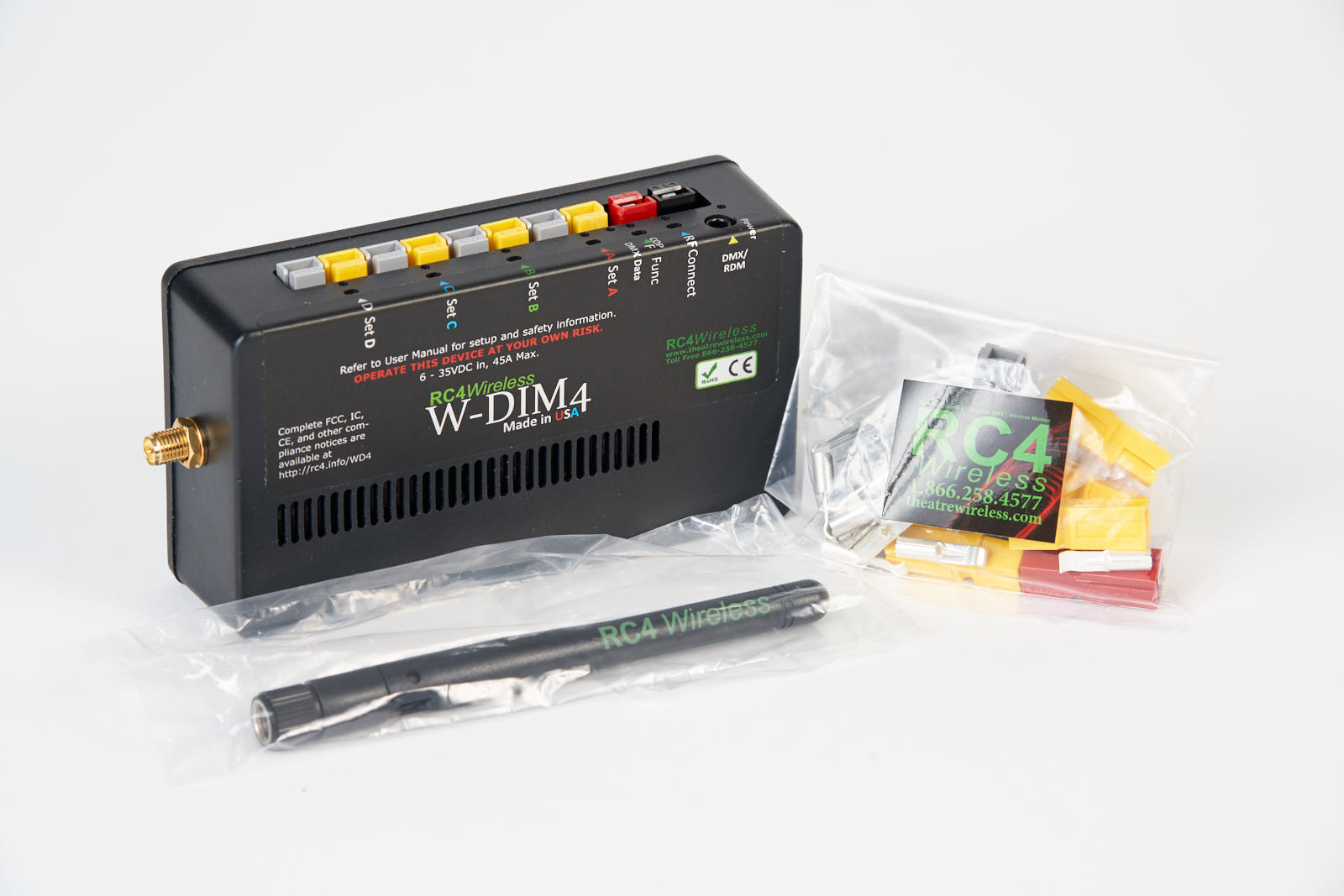
W-DIM is the first and only portable wireless dimmer for Wireless Solution W-DMX systems. It operates from 6V - 30VDC and provides 4 separate high-power dimmers. Use W-DIM with incandescent lamps (incl. MR11 and MR16), LEDs, low-voltage fog machines (incl. the Look Solutions Tiny Fogger), motors, solenoids, relays, power inverters, and more.

W-DIM Overview

The RC4Wireless W-DIM for W-DMXTM is a low-voltage 4-channel wireless dimmer. It communicates with Wireless Solution W-DMXTM transmitters and other W DMXTM components. W-DIM is the ideal way to add wireless dimming to an existing W-DMXTM system, making it easy to put lamps, motors, relays, solenoids, and more, in hand-held props, moving sets pieces, and other hard-to-reach or mobile positions and locations.

W-DIM will operate with 6V to 30VDC input and provide up to 200W per output at 12VDC. W-DIM uses a high-efficiency switching power supply and high-frequency pwm (pulse-width-modulation) dimming to provide high output power with minimal heat and power loss. Dimmer outputs are thermally protected and overload protected. Under most fault conditions, individual dimmers will disable themselves until the problem is corrected.

All buttons and indicators are recessed below the case surface, to avoid inadvertent operation. Buttons can be operated with a pen tip or other small pointer.

W-DIM Test Modes

There are two W-DIM test modes:

Bump Buttons

The button for each dimmer will momentarily turn the dimmer on at 75% when pressed. The indicator LED will come on, along with the connected load. Use this to check your wiring, connections, and lamps.

Dimmer indicator LEDs are after the internal fuse and will not light if the fuse is blown.

Chase Test

Hold the Chan Assign and tap the W-DMX button to put the dimmer into a cycling chase. Each channel will fade up and down in turn, over and over. Tap the W-DMX button to stop the chase.

Inverse Square Law Dimming and LEDs

W-DIM pwm dimmers are capable of very high resolution, making them ideal for smoothly dimming LEDs. To look smooth to the human eye, LEDs must be dimmed with an Inverse Square Law (ISL) curve, demanding very small changes in level at the bottom of the curve. At maximum resolution, W-DIM can deliver ISL dimming with 16,384 steps, so a single step level change represents 0.0061% of full level. Compare this to standard linear DMX dimmerswith 256 steps that each represent 0.3% of full level.

To achieve maximum resolution, the frequency of pwm pulses must be decreased. With 16,384 steps, W-DIM still updates levels 1,500 times per second. Compare this to the 60 Hz power line driving conventional fixtures.

The disadvantage of updating at 1500Hz is that it can be audible. If an incandescent lamp is used with the highest resolution ISL curve, the filament will noticeably sing.

For the highest possible ISL performance, all 4 W-DIM dimmers must be set for ISL output.

Linear Dimming and Incandescent Lamps

When a linear dimming curve is used with an incandescent lamp, resolution is less critical, and singing filaments can be annoying. To achieve the lowest lamp noise, the frequency of pwm pulses must be increased. With 1024 steps, W-DIM updates levels 25,000 times per second. This is well above human hearing, and still provides a resolution that is 4 times higher than traditional DMX dimming.

For high-frequency silent operation, all 4 W-DIM dimmers must be set for linear output.

Non-Dim Switched Output

Some loads, including relays and power inverters, must be provided with simple on/off non-dim power. The non-dim output option ensures this will be the case, and includes level hysteresis: the source dmx level must rise about 53% to turn on, and drop below 47% to turn off. This ensures that the load will not oscillate if the source signal is jittery or sitting around 50%.

Non-dim mode is less complicated than pwm dimming and can provide faster responsiveness. While responsiveness is never a problem in any W-DIM output mode, the fastest possible routines are used when all 4 W-DIM dimmers are set for non-dim output.

W-DIM Specifications

RF

Wireless Solution W-DMX Protocol
Frequency Range of operation: 2405 - 2479 MHz
Channel bandwidth: 1 MHz
Sensitivity at 0.1% BER: -96 dBm
FSPL Link range with 5dBi external antenna: 3232 m
Range with standard 2dBi antenna (measured): 500 m

Dimmers

Connectors: Anderson Powerpole, 1 set of mating connectors and contacts provided with unit

Maximum Internal Fuse : 25A (fuse must be rated for 32V or higher)
Power Input: 6VDC – 30VDC (12V typical), 50mA minimum, plus requirements of connected dimmer loads
Dimmer Outputs: 4 individual dimmer channels, each with independently assignable DMX channel and dimmer curve

Maximum PWM Frequency (Linear Curve): 25kHz at 11-bit resolution
Maximum PWM Resolution (ISL Curve): 14-bits (16,384 steps) at 1.5kHz

Dimmer Technology: MOSFET PWM (pulse-width-modulation)
Over-temperature protection: YES
Over-current protection: YES
Absolute Maximum Output Current per Dimmer: 42A
Absolute Maximum Input Voltage: 30VDC
Typical Continuous Output Current per Dimmer: 18A
Surge Clamping Voltage: 42V

RELIABLE TOTAL OUTPUT POWER IS LIMITED BY DUTY CYCLE, AMBIENT TEMPERATURE, AND CIRCUIT-BOARD TRACE SIZE. Dimmers will automatically disable themselves if overheated.

User changeable Bussmann ATC load fuse should not exceed 25A and should be fast-blow type. For total loads exceeding 300W, individual fuses for each dimmer should externally return to the external +V positive power supply.

HIGH-CURRENT DC POWER CAN BE DANGEROUS. ALL WIRING SHOULD MEET APPLICABLE LOCAL AND NATIONAL ELECTRICAL CODES. Ensure adequate ventilation and keep wire lengths short when running this workhorse dimmer at maximum capacity. Do not allow the unit, wiring, or connectors to run hot. USER ASSUMES ALL RISK.


R080212.1